The Dietary Guidelines for Americans (DGA) guide Americans toward the foods that are recommended to build a healthy diet, including foods that people love, like cheese. If you’ve ever wondered if and how cheese might fit into a healthy diet, we’ll break it down for you here.
Overview of the 2025-2030 Dietary Guidelines
The Dietary Guidelines for Americans (DGA) play an important role in US food policy and programming, but they also provide guidance for consumers when making everyday food choices.
The DGAs are released every 5 years and are typically updated based on the latest science on food, food patterns, and health. They give Americans an idea of what foods they should be including in their diets and how much they should eat.
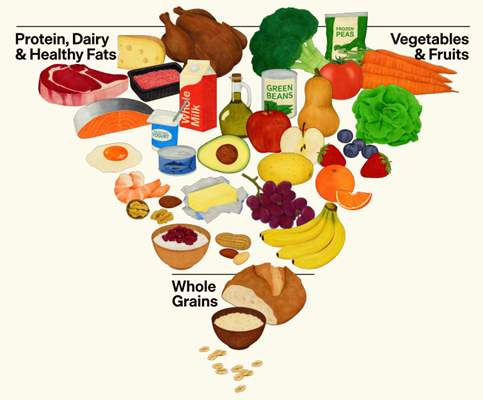
The most up-to-date version of the guidelines emphasizes protein at every meal, focusing on healthy fats, and includes 3 servings of dairy a day for most adults including cheese.
How Does Cheese Fit into the Dietary Guidelines?
Dairy gets a spotlight at the top of the pyramid in the updated DGA this time with a specific callout for Americans to consume dairy products. They recommend including at least 3 servings a day for most Americans, which can include full-fat dairy products such as cheese.
Dairy products, including cheese, are a good source of protein and contain nutrients that many Americans don’t get enough of, including calcium.
The new guidelines also suggest that full-fat dairy products containing no added sugars can help meet the recommended dairy intake. Unlike many yogurts and even some milk products, cheese doesn’t have added sugars and is a nutrient-rich dairy choice.
1 oz of Ellsworth cheese and cheese curds contains 190 mg of calcium, 6g of high-quality protein, and no added sugar.
Nutritional Value of Cheese
Hard cheese, including cheddar cheese and cheese curds contain a variety of nutrients that support health.
serving (1 oz.) of cheese and cheese curds has:
- 100 calories
- 9g fat
- 5g saturated fat
- 1g carbohydrates
- 0g sugar
- 6g of protein
- 190mg calcium (15% DV)
- 15% DV Vitamin B12
- 15% DV Selenium
- 10% DV Phosphorus
- 10% DV Zinc
Cheese and Heart Health
You’ve probably heard, and it is still emphasized in this version of the DGA, that saturated fat should be kept to under 10% of our calorie intake. A high saturated fat intake is associated with a higher risk of heart disease.
And yes, cheese is high in saturated fat, but we are learning that not all saturated fat is created equal. The saturated fat in cheese may not increase the risk of heart disease and may not impact cholesterol levels as we’ve thought. Research is ongoing, but several recent studies support this.
How do we think this works? Food is made up of a variety of nutrients, and how they interact with each other may be the key. Rather than focusing on one nutrient (saturated fat) causing an increase in cholesterol levels or increased risk of heart disease, researchers are now looking at the impact of different foods on health and health outcomes.
This mix of nutrients in a food is called the food matrix, and cheese and dairy products have their own matrix, which separates them from other foods high in saturated fat. More research is needed on how the cheese matrix works, but we are learning that including a serving of cheese can be part of a healthy diet and has many positive health impacts.
Including Cheese as Part of a Healthy Diet
How much cheese should you eat in a day? The DGA recommends 3 servings of dairy products for most Americans and suggests getting this through a variety of foods. This includes cheese, yogurt, and milk.
A serving of cheese is 1 oz, or about a 1-inch cube of cheese, or about 3 average sized cheese curds, or about ¼ cup of shredded cheese.
Try some of these ideas to add a serving of cheese or cheese curds to your day.
- Add shredded cheese or cheese curds on top of a salad.
- Mix shredded cheese into scrambled eggs for an extra protein boost in the morning.
- Make a quick snack board for an afternoon treat with some seasoned cheese curds, crackers, and sliced veggies.
- A sliced apple with cheese curds for a mid-morning snack.
- Mix cheese curds with turkey, arugula, sliced cucumbers, and tomatoes for a filling lunchtime wrap.
Bottomline
Cheese can fit into a healthy diet when eaten in appropriate portions and when enjoyed as part of an overall healthy diet and lifestyle pattern. Ellsworth cheese curds and natural cheese products are high-quality protein products. They come in a variety of flavors and styles that fit every lifestyle, from curds to block cheese to artisan half-moon cheese.
References
Fontecha, J., Calvo, M. V., Juarez, M., Gil, A., & Martínez-Vizcaino, V. (2019). Milk and Dairy Product Consumption and Cardiovascular Diseases: An Overview of Systematic Reviews and Meta-Analyses. Advances in nutrition (Bethesda, Md.), 10(suppl_2), S164–S189. https://doi.org/10.1093/advances/nmy099
Givens D. I. (2022). Saturated fats, dairy foods and cardiovascular health: No longer a curious paradox? Nutrition bulletin, 47(4), 407–422. https://doi.org/10.1111/nbu.12585
Torres-Gonzalez, M., & Rice Bradley, B. H. (2023). Whole-Milk Dairy Foods: Biological Mechanisms Underlying Beneficial Effects on Risk Markers for Cardiometabolic Health. Advances in nutrition (Bethesda, Md.), 14(6), 1523–1537. https://doi.org/10.1016/j.advnut.2023.09.001
Vissers, L. E. T., Rijksen, J., Boer, J. M. A., Verschuren, W. M. M., van der Schouw, Y. T., & Sluijs, I. (2019). Fatty acids from dairy and meat and their association with risk of coronary heart disease. European journal of nutrition, 58(7), 2639–2647. https://doi.org/10.1007/s00394-018-1811-1
About the Author:
Laura Ali is an award-winning registered dietitian and certified culinary nutritionist. She specializes in food and nutrition communications and recipe development. Laura has over 30 years of nutrition experience and holds a Master’s degree in nutrition from the University of Pittsburgh and Bachelor’s degree from the University of Dayton. She loves sharing ways to incorporate delicious, healthy food into everyday meals.
About the Author:
Laura Ali is an award-winning registered dietitian and certified culinary nutritionist. She specializes in food and nutrition communications and recipe development. Laura has over 30 years of nutrition experience and holds a Master’s degree in nutrition from the University of Pittsburgh and Bachelor’s degree from the University of Dayton. She loves sharing ways to incorporate delicious, healthy food into everyday meals.
